News
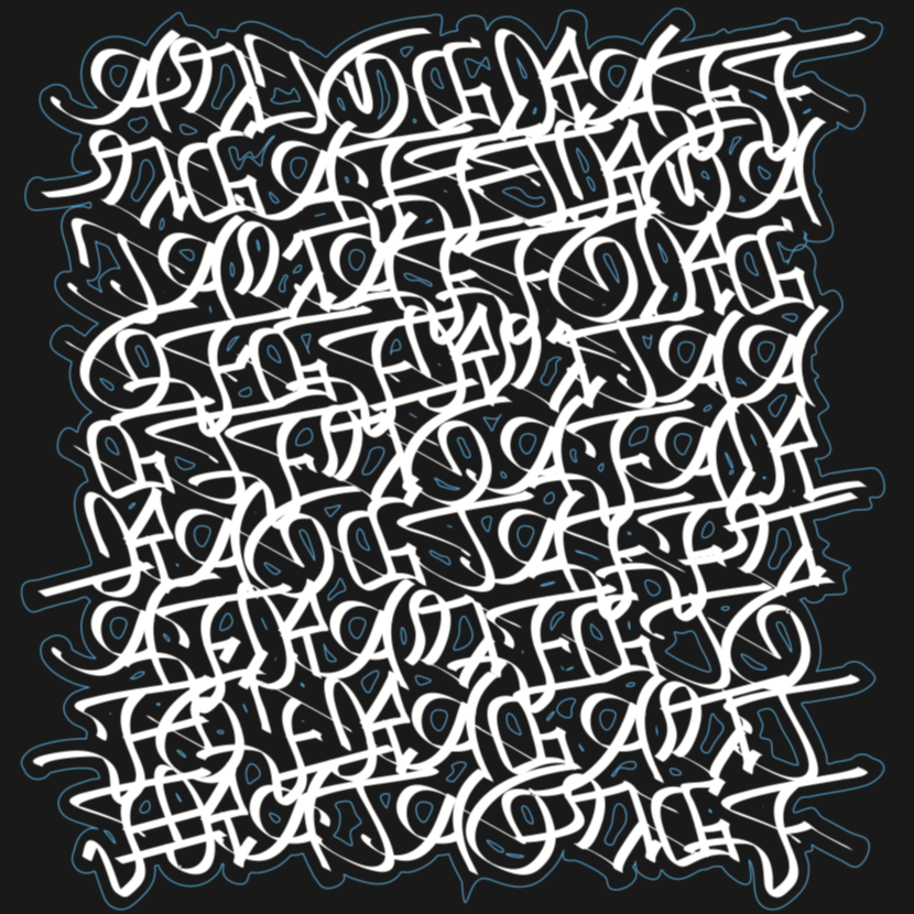
How can computing tools and robotics support graffiti art and calligraphy? Programmer and artist Daniel Berio presents and demonstrates the use of ”stroke primitives” as building blocks in his design and art.
“In this edition of PassW0rd we ask the question can AI be creative?
It’s one of the burning issues of the 21st century as AI begins to be tasked with challenges that would defeat a human being such as finishing off Beethoven’s 10th Symphony from notes and fragment the musical genius left when he died or predicting the next notes in a Bach composition.”
Keynotes & Workshop
- „European ARTificial Intelligence Lab” – Veronika Liebl, Ars Electronica
- „Occupy White Walls. Democratise ART” – Yarden Yaroshevski, StikiPixels
- Liat Grayver (Künstlerin), Justine Emard (Artist), Mattis Kuhn (Artist) and Andreas Greiner (Artist) together with AI Design Sprints™, 33A
The 35th Chaos Communication Congress (35C3) 2019
Brush in hand, dip into the paint and paint away! It seems easy for us humans. But when a robot is supposed to paint with a brush, things often go wrong. And then it spills.
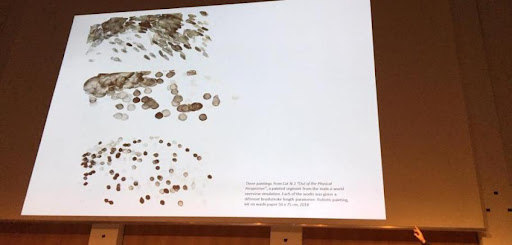
Liat Grayver (Artist in Residenz Excellence Cluster Fellowship“Cultural Foundations of Social Integration”,) the e-David team Marvin Gülzow, Casa Paganini InfoMus, and Dr.Antonín Šulc
The space brings together several collaborative works that varyingly employ robotic technologies, motion tracking, video, and painting. As a whole, this body of works investigates the relation between organic practices and machine-based systems, both of which are used to create structures from physical actions (operation) and from the mind (perception).
The e-David robot is positioned in the centre of the exhibition and continuously generates calligraphic- paintings. The data for the robot’s brushstrokes is generated from analysis of the visitors’ movements in the space, captured using a camera and custom motion-tracking software. As they enter the exhibition space, individual visitors’ movements are captured by the video camera, and their location and movement are translated into a digital trajectory that is projected on a large, transparent black screen. The individual trajectories are translated into brushstrokes painted by the robot on a long rice paper roll, which is advanced by a paper feed. At the end of each day, the roll is fully painted with different calligraphic lines describing the movement of visitors throughout the space. These are hung in the gallery space on custom-made frames functioning as evidence and testimony of each of the days the exhibit runs.
Liat Grayver was at the Centre Pompidou, on March 28, 2019, during the STARTS Residencies Days. Discover her residency with the WeDRAW Project in this video.
The robot e-David is a painting robot. He is in Switzerland for the first time and will be demonstrating his skills at the grafikSCHWEIZ18 trade fair in Zurich.
Is there a “formula” for art? If so, e-David, a robot created by computer scientists at the University of Konstanz in Germany, may help solve it.
The brush-wielding bot, whose name is an acronym for “drawing apparatus for vivid image display,” sports a camera, a palette of 24 colors, and software that lets it calculate just where to put the paint to create a predetermined image. Once the painting is complete, e-David even eerily signs its work