Licia He
REIMAGINING ROBOTIC PAINTINGS THROUGH CHALLENGING MATERIALS
Personal Biography
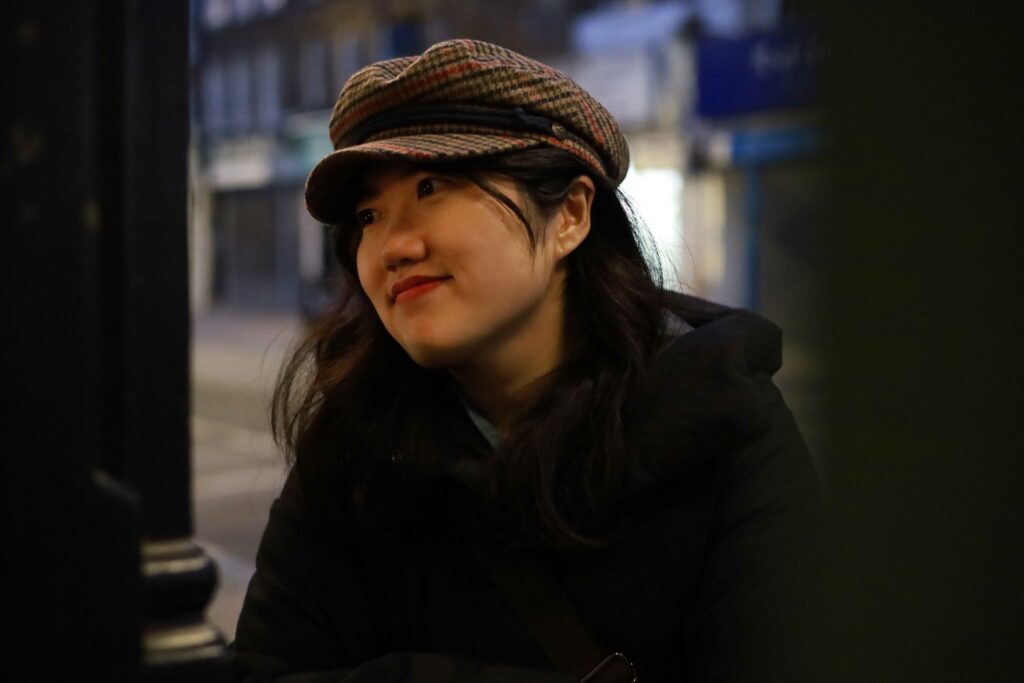
Shiqing (Licia) He is a Chinese generative artist and a human-computer interaction researcher dedicated to creating artistic expressions through technological innovations. With a Ph.D. in Information Science and a Bachelor of Science degree in Studio Art and Computer Science, Licia currently resides in London (United Kingdom) as a full-time artist, focusing on capturing and presenting information around her through visual art. Fascinated by the possibilities of human-machine collaboration, Licia’s explorations led her to combine generative art with robots, bridging her digital and physical painting practices through pen plotters.
She previously served as an assistant professor at Texas A&M University, School of Performance, Visualisation, and Fine Art (Texas, United States), where she founded the Generative Craft Lab. Licia is best known for her code-based, robot-rendered art. Her works have been exhibited and collected worldwide through venues such as Art Blocks, Bright Moments, and Feral File.
Project
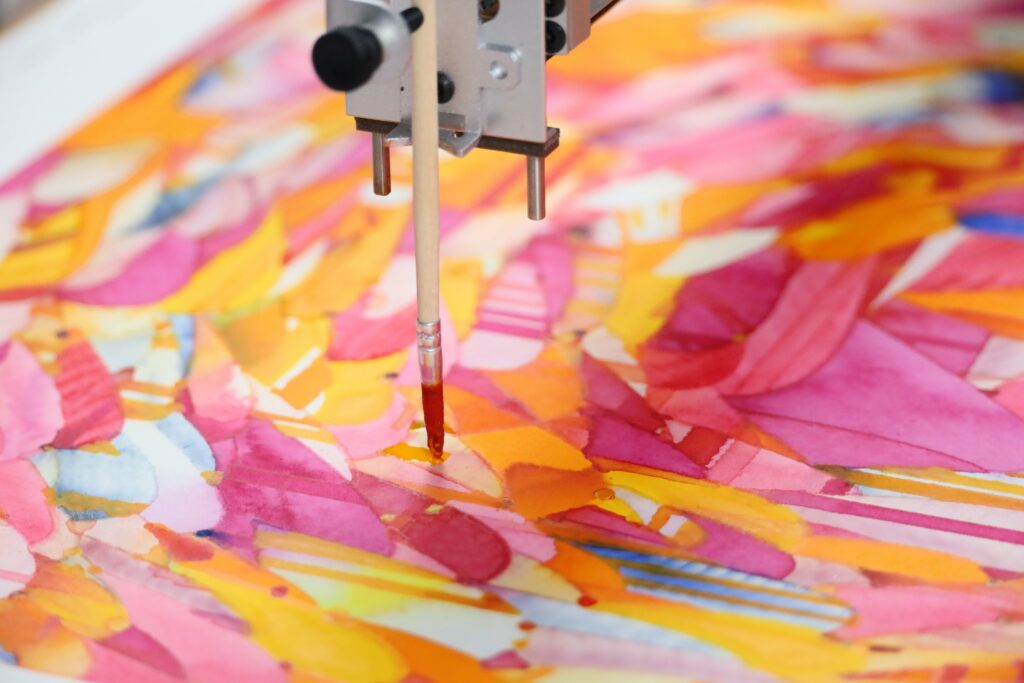
Robotically-rendered drawings and paintings have a rich history of delivering code-based art to the physical world. Despite this deep connection, common perceptions towards robotically-made paintings remain stereotyped and incoherent. While many view robot-rendered art as a threat to handmade art, others consider robots too simple to create anything beyond basic geometrical graphs. I am passionate about deepening our understanding of the relationship between machines and creative expression: how machines are not merely enhancing creative expression; they enable creative expression.
Through this project, I aimed to examine robots’ potential in finding new frontiers of traditional painting techniques that involve challenging materials. Specifically, I did focus on exploring two directions: natural pigment and paste-like paints.
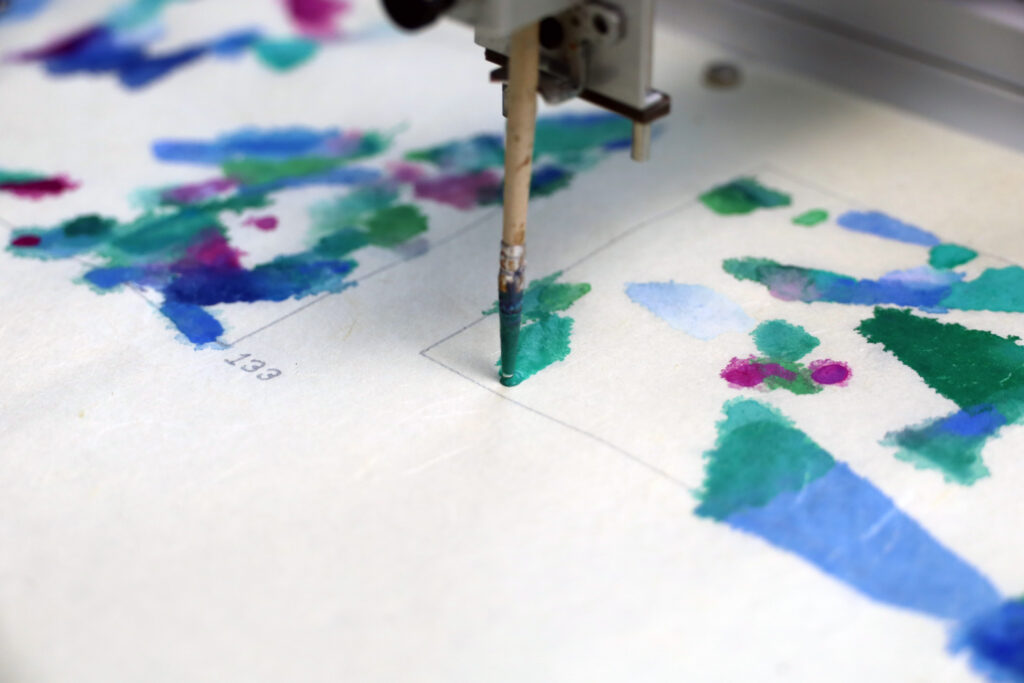
- Painting with mineral and other natural pigments robotically: Compared to conventional painting materials like watercolour and oil paint, mineral pigments are much more challenging materials to paint with: they require more customised binder mixing, specific brush movement, and complicated layering techniques. I am interested in examining if and how human-robot collaboration could extend the expressiveness and affordance of this ancient art-making material.
- Creating impasto paintings with robots: impasto painting is a mark-making technique that creates 3D texture using thick paint. Typically painted with palette knives, impasto paintings are known for their exciting texture and complicated layering methods. I am interested in identifying a set of robotic gestures that can apply thick paint expressively. I also want to compare how the differences and similarities between robot and human gestures would result in different textures.
Recent Developments
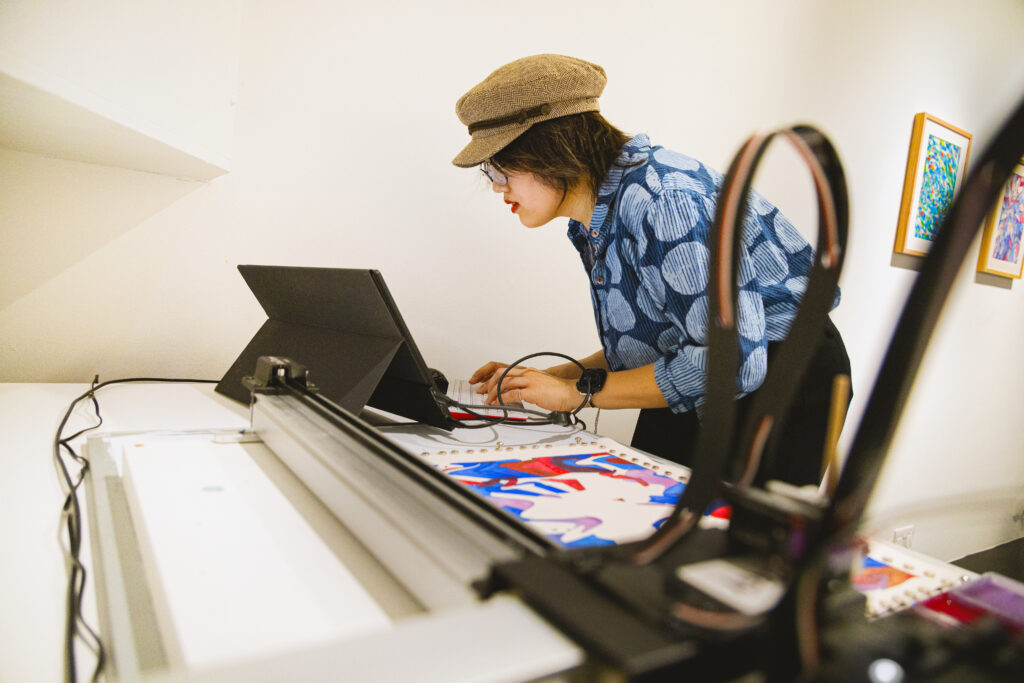
In the last 3 months of my residency within EACVA, I focused on exploring materials and building physical tools and setups for robotic paintings. I tested a variety of painting mediums and pigments, specifically focusing on their potential usage on plotters. I also designed several tools for the plotter painting practice, such as pen adaptors and paper stretchers.
Exhibitions, collaborations during or in relation to my EACVA residency:
- Yarntificial City: Responsive Dreams 2026, The Generative Art Museum . Featuring Agoston Nagy, Alba G Corral, Alicia Champlin, Anna Carreras, Anna Lucia, Bruce Yoder, fingacode, Hector AKA Rotceh_303, Ioana Vreme Moser, Lev Manovich, Licia He, Lukas Truniger, Marc Vilanova, Marta Verde, Mayte Gómez Molina, Mónica Rikić, Myriam Bleau, Roxanne Harris, rudxane, Spongenuity, Stefano Contiero, and Takk Iori. Granollers, Barcelona, 2026.
- Road Trip In The Repository (Please Respond), Tyler Hobbs Studio and Shape. Featuring Tyler Hobbs, fingacode, Mathias Isaksen, mpkoz , Kjetil Golid , Juan Pedro Vallejo, Licia He, Juan Rodríguez García, Aleksandra Jovanić, and Zancan. Virtual, 2026.
- EMULATION: Selections from the Art Blocks 500, The Museum of Art and Light. Featuring Sterling Crispin, Loie Hollowell, Carolina Melis, Kelly Milligan, MountVitruvius, Grant Oesterling, Harvey Rayner, Marcelo Soria-Rodríguez, Iskra Velitchkova, and Licia He. Kansas, United States, 2026.
- In Conversation With Jacoba, a collaboration between Licia He and Claudia Hart for Hart’s installation Empire Failure. Commissioned and presented at Pixel Pioneers by the Museum Boijman Van Beuningen. Rotterdam, Netherlands, 2026.
- “Painting With Plotters”. Participatory Event, The Digital Art Weekend, Victoria and Albert Museum (https://www.vam.ac.uk/event/9pmbZOVdEw/digital-design-weekend-2024), 20-22 September 2024.
- “Painting With Plotters”. Presentation. Peckham Digital, July 2024.
- “Developing Generative Plotter Paintings”. Presentation, Non-Generative AI and Art Conference, June 2024.
- “I Have To Talk To A Plotter”. Solo Exhibition, GAZELL.iO (https://gazelliarthouse.com/exhibitions/183-i-have-to-talk-to-a-plotter-licia-he/), June 2024.
Links
Name: Shiqing He (Legal Name)
Licia He (Preferred name for all mentions/prints/displays)
Email: mailto:liciahe@gencraftlab.com
Website: https://www.eyesofpanda.com/
Instagram: @blahblahpaperblah
Twitter: @licia_he