Atelier Goldsmiths
History
The DrawLab at Goldsmiths has recently joined the EACVA project. The lab features a collaborative robot arm (from Franka Robotics) equipped with vision feedback, as well as pen-plotters. Both platforms can be easily adapted with different kinds of drawing tools. While less mature than the Konstanz lab, the Goldsmiths lab is under rapid development and provides additional flexibility when implementing safe artist-robot collaboration scenarios.
Research highlights (EACVA 2023–2026)
During EACVA, the Konstanz and Goldsmiths teams worked together on how a robot can turn an image into a painting that looks – and is made – more like the work of a human painter. Each project below links to a full paper. Below are research items led by Goldsmiths; items led by Konstanz are summarised here: https://www.doc.gold.ac.uk/eacva/wp/index.php/atelier-konstanz/
Long, smooth strokes: Neural image abstraction with B-splines
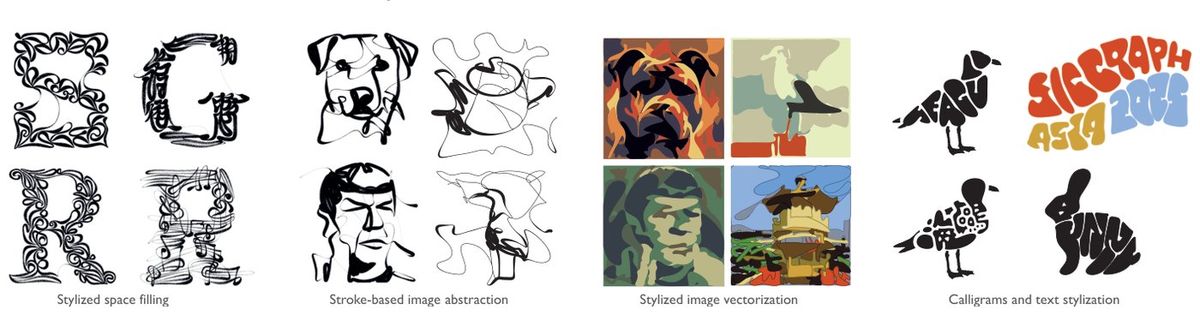
Digital vector graphics usually build long lines by gluing together many short curve pieces – but a brush, a pen or a robot arm works best with long, continuous and smooth movements. We integrated smoothing B-splines into a differentiable rendering pipeline. This lets modern image-based AI methods directly optimise long, smooth paths and control the trade-off between fidelity and simplicity, as well as the style of the strokes.
Paper: Berio, Stroh, Calinon, Fol Leymarie, Deussen, Shamir. Neural Image Abstraction using Long Smoothing B-Splines. ACM Transactions on Graphics 44(6), 2025 (SIGGRAPH Asia). doi.org/10.1145/3763345
Drawing like a human hand: rapid lognormal movements
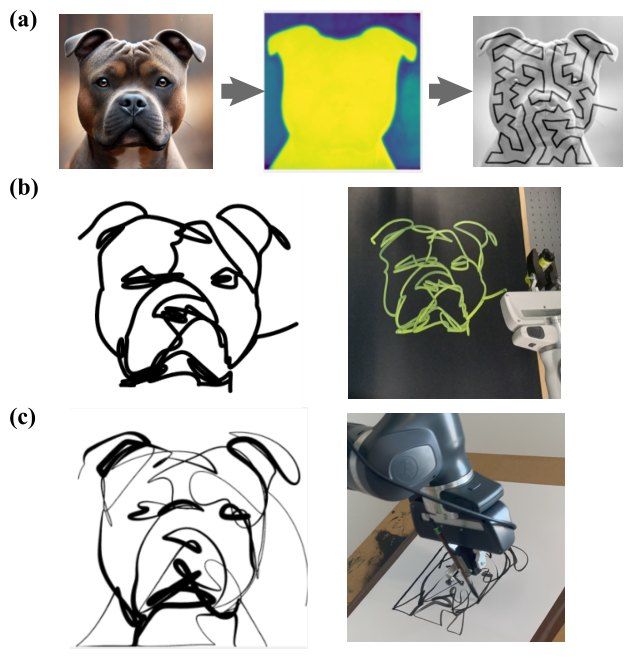
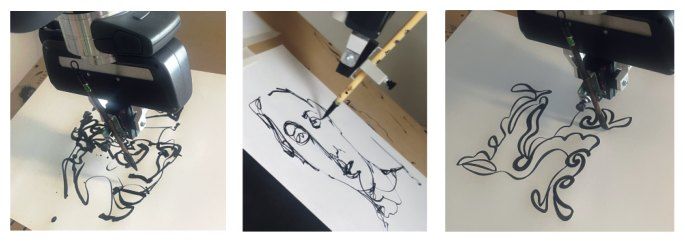
Human drawing and writing are fast, skilled gestures, and the way a hand speeds up and slows down shapes how a line looks. The sigma-lognormal model from the “Kinematic Theory of Rapid Human Movements” describes exactly this. We adapted the model so that it works inside a differentiable vector graphics pipeline: an AI can now optimize natural, human-like drawing motions guided by an image, and the resulting trajectories can be executed by a robot.
Applications include robotic graffiti tags and single-line drawings guided by images or text.
Papers:
Berio, Clivaz, Stroh, Deussen, Plamondon, Calinon. Image-driven Robot Drawing with Rapid Lognormal Movements. IEEE RO-MAN 2025. doi.org/10.1109/RO-MAN63969.2025.11217913
Berio, Calinon, Plamondon, Fol Leymarie. Differentiable rasterization of minimum-time sigma-lognormal trajectories. IGS 2025. PDF
Available painting machines
Franka Emika Research 3 (FR3)
The FR3 is a seven-axis collaborative robot (cobot) that is widely used within the robotic research community (https://franka.de/franka-research-3). Its 7 degrees of freedom (DoF) result in a level of articulated motions similar to that of a human arm, a feature that is particularly useful when controlling the orientation of a drawing tool. The FR3 is designed to enable full customisation of its control loop, enabling the implementation of controllers that can react to perturbations with varying stiffness levels. The robot has 2 “guiding” buttons on the wrist that allow a user to rapidly demonstrate and record motions that can be replayed by the robot.


The FR3 drawing on a tilted canvas and holding different drawing tools. Images by Daniel Berio 2023
Drawing tool attachment
Drawing tools can be easily used by the robot through a custom-built 3d printed attachment that connects to a screw-based pen holder identical to the one used by the AxiDraw plotter. The attachment is designed so it fits tightly in the robot’s gripper, enabling simple switching between different tools.

Drawing pad
The robotic arm is mounted on a workbench in front of a custom-built drawing pad with adjustable inclination. The drawing pad is constructed with aluminium profiles and can be easily extended with pen/brush holders and palettes. The guiding mode of the robot can be used to create new motions for picking/placing drawing tools rapidly or to reach palettes and ink/paint containers.
Vision system
The robot is equipped with a wrist-mounted Intel Realsense D435 color and depth camera. We also provide a higher-resolution Canon EOS 2000D camera, which can also be controlled programmatically.
Software
The control software is currently under heavy development. It currently enables recording and replaying recording demonstrated motions such as picking/placing, calibration of the drawing plane, path planning, computing the inverse kinematics for drawing tool trajectories, visualising the resulting joint trajectories, simulating the behaviour of the robot, and finally executing the motions with the robot. The software is mostly written in Python with a C++ back-end and is easy to extend and customise while taking advantage of the rich Python library ecosystem. The software can also be easily interfaced with the Robotics Operating System (ROS) but currently does not require it to run.
AxiDraw SE A3
The Draw-lab also provides access to an AxiDraw SE A3 pen plotter. A popular choice among digital/generative artists, the AxiDraw is an easy-to-use pen plotter that can be easily equipped with various drawing tools and easily controlled through the vector drawing program Inkscape or a Python programming interface.

AgileX Nero
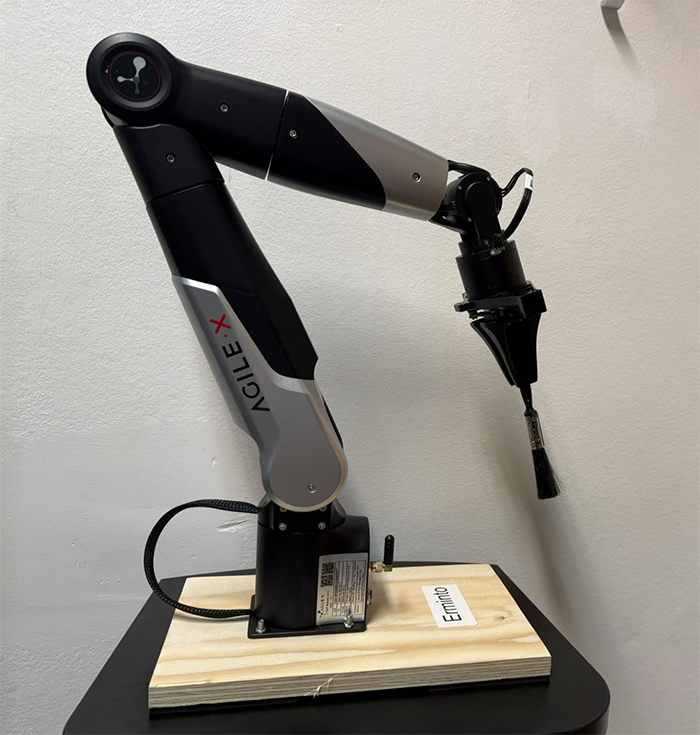
Our latest addition to the lab is a AgileX Nero robot arm. It offers 7 axes alike the Franka Emika robot but has a smaller form factor, while still enabling low level control.